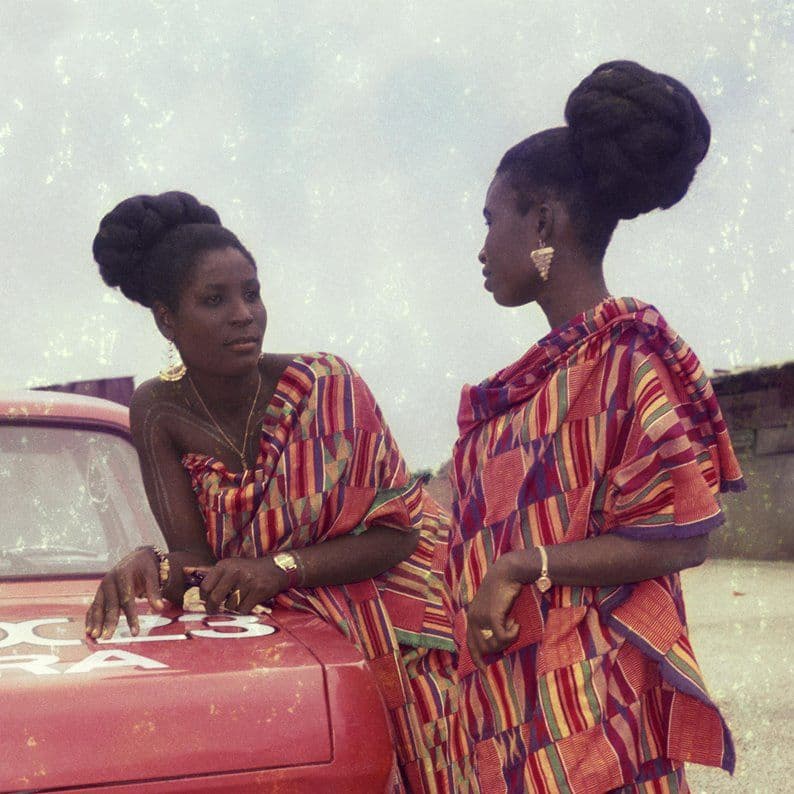
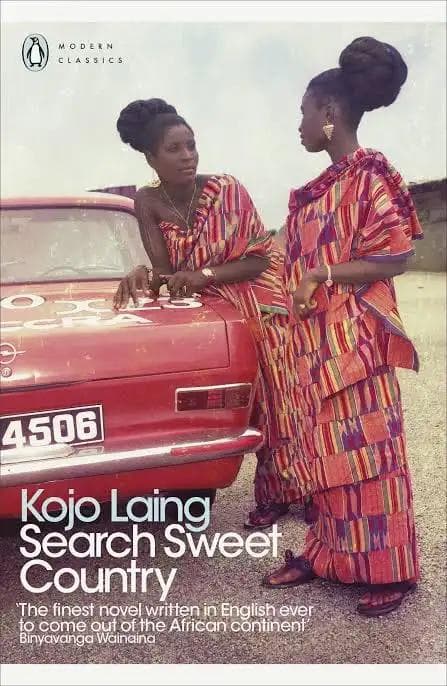
Kojo Laing’s Search Sweet Country (1986) records Accra in the mid-1970s under Ignatius Kutu Acheampong's military regime. Laing domesticates the English novel format. The prose combines Twi, Ga, Hausa, and Pidgin with Oxbridge English. The invented words and localised syntax track the neuroses and physical weariness of a city under authoritarian rule. Accra provides the background, while the individuals drive the narrative through their desperate and deeply physical searches for stability.
The book leaps between a large ensemble of characters, connecting their paths through shared spaces and linguistic friction. The terrain is built from the bodies and the dialogue of these citizens.
Professor Kwesi Sackey represents the paralysed intellectualism of the Acheampong era. He views the Ghanaian intelligentsia with contempt, diagnosing their failure while trapped within it. His physical presence matches his ideological rigidity. He walks with 'long strides' that leave his companion, Dr Andy Pinn, ambling behind like a 'wise duck.' Sackey critiques the 'modern carpenters of the head' making chairs to 'preset designs,' furious at a society that leaves theories for 'bright and unoriginal professors to tussle with.' His environment reflects this failure. The August grass outside his bungalow is 'going brown,' displaying the 'daily history of all Sackey’s frustrations.' The bungalow feels inert, described as a ‘piece of brodo with the yeast of his wife’s indifference rising slowly inside it.' The hibiscus outside is 'red with doubt.'
Sackey’s physical reactions expose his lack of control. A 'livid' Sackey stops his car abruptly to eject the farmer-priest ½-Allotey, shouting he has 'no room in my car for mathematics.' He declares one man plus another man will not be in his car, demanding the unauthorised passenger get out. His skin holds a 'heat and a tightness' when he lectures Sally on the moral failings of the nation. The psyche, he argues, is 'frozen,' stuck in a 'bush trap, big enough to catch the rat-spirit.' This immobility results in a multi-cultural confusion where individuals fall back on the 'transcultural carpenter’s shop' to justify inaction.
Sackey notes that action is taken out of its real scale or viewed as a great sacrifice. Immobility creates meaning by assuming the roles of paradox and rest. When it comes to moral action, Sackey insists the basis of righteousness is twisted from its psychic root. He uses a 'confused koobi' to describe the populace. There are justifications, denials, helplessness, and the projection of responsibility onto others. The people take advantage of different cultures to justify an action based on one culture when it should be based on another. They embrace a festival spirit just when there should be a work-ethic spirit, justifying the ease as 'true' to their own culture and leaving it at that 'ridiculous junction of authenticity.' Sackey shouts 'shame to them,' demanding an intellectual rigour of 'atua squared times guava cubed.'
He extends this critique to the communal work ethic. The individual psyche feels responsible for the 'so-called masses' while engaging in a 'wild race to keep one’s status and position intact.' He highlights the 'sideways glances' and 'moral sidesteps' of colleagues noticing who is piling up material things, like a new car or a new freezer. He expresses annoyance at the 'cacophony of screeching, screaming wind-ed anthropologists creating their noisy music over such a quiet past.' He demands the internalising of 'spirits, totems, ancestors, ghosts, okra, sunsum, ntoro, mogya, our Nyame, our God, our values.' He states that when offered the choice between a perfect soul and a 'brand new super-dupe Mercedes Benz 450 automatic,' almost all Ghanaians would 'postpone their souls, and rush after the Benzes.' He condemns politicians, labourers, clerks, and soldiers alike.
Sofi Sackey counters Kwesi’s volatile theorising with tactical intelligence. She manages the immediate reality of their home. The smile of welcome she wears shines brightly before visitors even knock. When policemen arrive looking for her husband over the Anyinam snakes, Sofi intercepts Kwesi. She thanks Dr Pinn sweetly and asks him to return in an hour, noting, ' and I don’t mean a Ghanaian hour.' She leads her 'angry, confused Sackey' down the drive, whispering to him to be calm for a change, neutralising his temper.
Sofi creates an 'arena of smiling' in her lounge. She offers the policemen water and palm-wine alongside Mrs EsiMay Pinn. She establishes dominance, looking like a sister to Mrs Pinn, with each move 'calculated to be ahead of anything the policemen would do.' She disarms the Sergeant with flattery, suggesting he looks familiar and might have done a course at Legon. This forces the policemen to relax their formal posture. She protects her husband by managing the physical space of the room.
The policemen demonstrate the absurdity of military rule. Addo and Akakpo, the officers attempting to deal with the snakes, reduce law enforcement to a farce. Addo fears a snake that is 'attracted to corporals,' noting the last person it bit while it spoke held that rank. When the narrator walks toward him with a harmless grass snake, Addo demands he halt in the name of the 'Anyinam law,' requesting 'conclusive proof of your whiteness.' Akakpo, the subordinate, refuses to intervene, stating, 'For me I not fit arrest man and snake.' When Akakpo impulsively holds out the other snake, Addo races into the station shouting, 'Retreat, Akakpo, retreat, the enemy de come, pasaaaa!' The vernacular 'pasaaaa' punctures the formal military command. Akakpo’s smile fills the street; he overpowers his 'cantankerous corporal' simply by holding the reptile.
The interaction in Sofi Sackey’s lounge further exposes compromised authority. The Sergeant sends his moustache ahead of him to the chair in a 'fine jut of confidence' and states he would 'arrest a ghost in the interest of the force.' The corporal attempts to match the formal tone, warning that Kwesi Sackey is close to deportation following something serious released 'forever in the anus of Ghana.' The Sergeant’s eyes redden with anger. He corrects the corporal, calling him a 'foko fool, paa' and clarifying the word is 'annals,' not anus. He justifies his patience by adding, 'we have to be democratic with the lower ranks.'
Agyemang’s existence is dictated by his biology and his disastrous marriage. His blood pressure, his 'BP petrol,' governs his daily anxiety. He fears his Aberdeen-trained doctor is lying to him about his health after he eats okros. The doctor’s 'smile that looks like the afterlife' terrifies him. The doctor refuses to guarantee his survival, stating he will keep Agyemang alive 'if God is willing,' leaving Agyemang in suspended medical terror.
Agyemang discovers his wife’s infidelity with a polite civil servant. He notes they say 'please' to each other several times before going to bed. Agyemang forces his BP 'right down by force' to write a letter transferring her 'thighs, and whatever cargo they contain' to her lover, Owura Puplampu. Agyemang questions how his 'supertobolo market mammy' wife could be late from the market at 10 p.m. because the fishermen had to catch the fish, joking she went 'marketing on the high seas' and picturing her buying tomatoes among the tossing waves.
His wife claims pregnancy. Agyemang knows they have had no 'fikifiki exercise' for over two years. He demands she not 'go hunting and come and put the harvest at my door.' His wife confesses her boyfriend is impotent and claims she performed 'kalabule' (fraud/smuggling) with Agyemang’s body while he slept. The maidservants, Kokor and the others, who used to hide behind the door to hear their 'entertainment,' heard nothing for two years, confirming the deception. Agyemang divorces her, only to impregnate Kokor. He equates her darkness and skin with forgetfulness, frustrated by his inability to take her to 'important parties' with his 'oiled arms.' He begs the Sister to terminate Kokor's pregnancy so he can avoid a clinic and his own 'deeper laughter.'
Old Man Boogie represents the 'clerk’s breathing world,' a space lacking the money and education required for 'more style.' He believes that with more funds, he could be dealing with computers or making wells in faraway villages. His shabbiness breaks cultural taboos. He lacks the expense to maintain the 'neatness that is supposed to stretch to the spirit.' The physical toll is absolute; the bags under his eyes are 'big enough to carry all the worries in his head.' He dreads dying in a 'strange limbo by an empty tin of ideal milk full of my own loneliness.' He desires 'softness' to resurrect his past and exercise his own 'hardness.' He plans to sneak toward Libo to pay for a woman's softness, questioning the difference between 'erection and resurrection.' He embraces the rejection of others due to his 'displaced energy,' taking solace in the universal fact that everyone will grow old. He notes the Afro girl with the 'marks-set go-go backeepers' will one day sleep holding her own wrinkles.
Osofo, the priest with 'enormous hands' and 'sharp strides,' demands immediate salvation from his congregation. He argues that God’s speed is limitless and questions why anyone would ask God not to save them quickly. The congregation pushes back. One member insists they must have some 'surviving to do' before God’s hands move again, warning that moving too fast might cause them to rush past God while He takes his afternoon sleep. The old man reminds Osofo of the strict economic reality: they have families to feed and cannot preach at concerts and parks all day.
The Bishop diffuses Osofo’s urgency with a 'height of the heart' and 'instant ritual.' He introduces a branch as a symbol of 'upliftment,' allowing the congregation to wave their love to God. Osofo holds his anger down by the 'soles of his sandals,' praying for patience that lets 'gari rise with the temptation of water, yet stop rising just at the right level.' The ensuing celebration involves drums, dancing, and flowers thrown at Osofo. The crowd moving through Madina breathes 'from yesterday’s deposits of darkness,' waving hands that cover faces pushing through the 'African void.' The air itself becomes a commodity, with people arguing over 'plots' in the air and planning to fill their air with hundreds of 'kaklo' for sale. Beni Baidoo shouts that Madina is moving so fast it would be posted 'air mail all the way to Accra.'
Allotey is a 'farmer-priest' who attacks Professor Sackey with unanswerable questions. He asks if Sackey is angry about 'garden-egg stew' or the 'tang of atua.' He questions if Ghanaians make history too slowly and if the leaders reflect the 'lowest common denominator.' He references witches' heels touching in the sun and okros of flesh being the most dangerous. He asks Sackey about the 'Akans’ philosophy of the human being as made up of the Okra, Sunsum, Ntoro, and Mogya.' He details his suffering at the 'hands of trees' and claims to come from a 'long line of fetish priests.'
½-Allotey states his broad hands can 'take all the suffering in this country.' He changes his hoe constantly from his right to his left, his huge chest heaving until it looks as though the 'earth grew on his back' and was trying to bury him. He claims all his women are witches, loving the 'memory of their absence' as soon as they leave and hating them when they reappear. ½-Allotey identifies the people as 'freefloating,' noting that 'when we float we sink, when we are free we get caught.' He argues the culture is too heavy and too slow, pointing out the expertise Ghanaians have in undermining each other. He recounts a dream where God has two eyes, the sun and the moon, and acts as His own 'shoeshine boy' polishing the moonshine eye. He demands Sackey bring some sociology into his village when it is completed, wanting a learned village where he learns hard things harder than his 'popylonkwe' in between fornication four times before a rich breakfast.
Ebo and Kwame Ti treat a bar in Madina as a theatre. Ebo acts as the hype man, declaring to a 'fat woman whose surplus skin was still fresh on her tray' that his friend wants to marry her immediately. He boasts of their endless beer and money. The woman, possessing 'all the cheeky thrust of Accra in her eyes,' takes a long draught of beer, makes the 'slowest swallow in Madina,' and dismisses him, telling him she hears 'foko' and to go without wasting her time.
Kwame Ti takes over. When he walks, the breeze holds his untidy waist 'like a chief was held when dancing.' He claims to have arranged with God for an 'extra five inches in instant height.' He confronts the woman, offering to 'type' her and stating he does his 'best work, lying down.' His assured elbows prop up the bar, even as the heavy music shakes the fat mama’s arms. Ebo claims to be 'sober in one lip,' while his lower lip is 'secretly kissed pink by witches that fly on and around it at night.' Kwame Ti staggers forward to try and open Dr Pinn's mouth to press his teeth, comparing them to the 'keys on our church organ' and wanting to see if music comes out.
Okay, Pol’s fez sits on his head 'like a child sat on a block of wood,' shaking as his upper jaw chews far faster than his lower jaw. He wears odd-colored joromies and over-thin trousers that give his legs the look of 'propelled pins.' He attempts to play the thumb piano with a wise beggar but gives up in disgust when Araba ignores him. He whistles loudly in unbecoming places. Araba treats these ways as entertainment and a 'flavour to her attraction.' She closes his mouth with a kiss when possible, nipping him to control her exasperation. She experiences a 'dry half' of her face presentable to the mirror while the other half deals with the rain of his oddities. Okay Pol blasts her eyes with the 'concentration of stored laughter.' He asks if she wants him to 'laugh above the control price' and warns against hoarding one's tongue.
Aboagye Hi-Speed is so thin that 'when he stood sideways, he disappeared.' He must face anyone he talks to, or he talks out of nothing. His tongue is 'fat with death,' resembling the 'oldest bit of pink chale-wate,' and his teeth angle back towards the 'cave of his throat.' His shadow is full of akpeteshie, and his voice is hoarser than sandpaper. He rejects the communal rituals of his family, deciding to organise his own 'automatic funeral.' He states he lived a fool's life and should be buried like a fool. He cares less for the Akan taboos requiring strangers to be buried with their feet facing their hometowns.
He reveals his secret plan to Adwoa Adde. He has tipped a Dagarti man to watch him stagger onto the steps in the midnight compound. The man will carry him to the hidden coffin in the cemetery and reveal the grave Aboagye dug secretly. The gravedigger will hand down twenty bits of rope tied onto boards holding the earth. Aboagye plans to pull the ropes, letting the lid crash down with its glue and the red earth follow. He chooses to crawl 'like a rat down into the five feet of grave,' avoiding communal mourning entirely. He prepares a letter to the Graphic about his 'automatic feat' so strangers will 'laugh and marvel.'
Kofi Kobi loses his wife because of 'leg reasons.' She slaps a piece of 'imagined ugliness' on his jutting chin, exaggerating its length to protect her emotions and finalise the divorce. They jump out of each other’s lives. He lands immediately in the lap of Akua Nyamekye, whose desire is 'hidden expertly in the look.' Kofi Loww navigates the city with a 'detached way,' smiling as if his teeth do not exist. He buys bananas from a woman complaining about her three children holding their noses to be wiped. Loww expects complaints from Adwoa Adde. He observes that all the stones of a guava point in different directions, and each stone could be 'subversive of love and action.' He recognises his own contradictions and 'small shame' in his slow explorations, wishing for a 'patterned way of variety' to fit into his heart and head.
Search Sweet Country records the friction of bodies moving through Accra. The juxtaposition of 'popylonkwe' with sociological theory and the collision of the 'Anyinam law' with the 'African void' reflect a populace refusing to remain static. The characters' search for dignity requires wading through the physical mud of the present moment.
Follow the writer emeka.lit